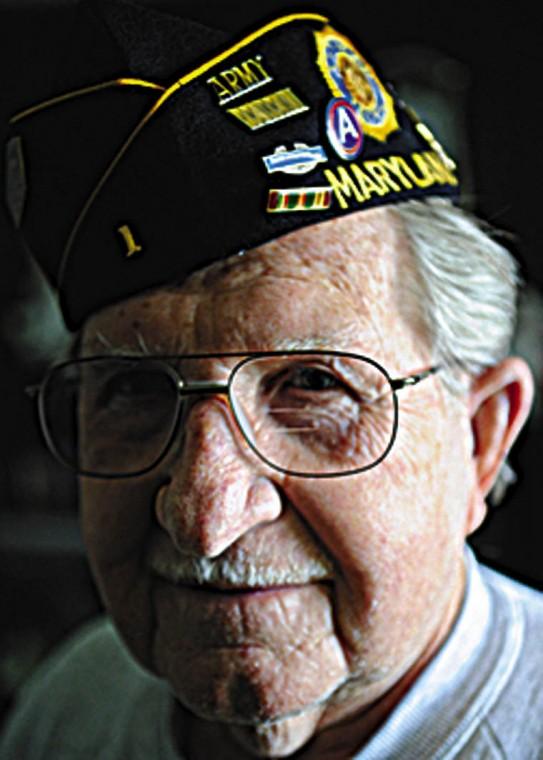
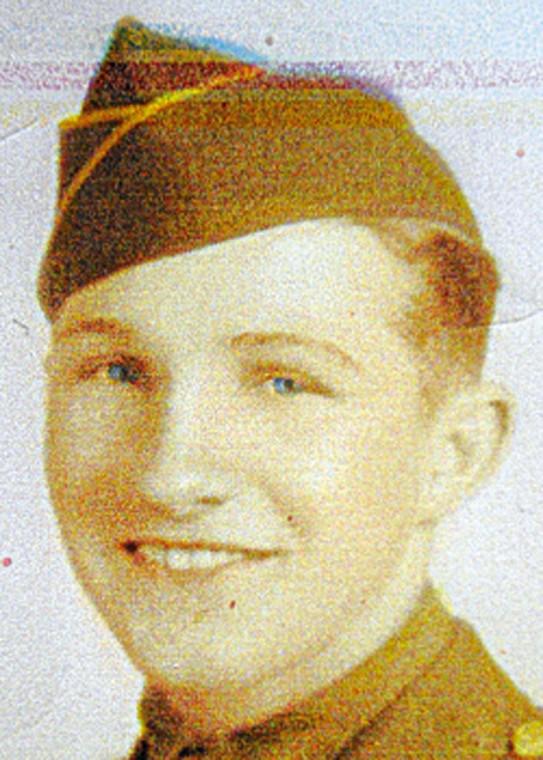
| For weeks I have been reading Bill Hall's articles about Carroll County's Veterans in the Carroll County Times.... And of course, Bill McKenzie came to mind. I sent an email to Mr. Hall several weeks ago, and last week he called me and said that he wanted to interview Mr. Bill for a story. Needless to say, I was elated!
Congratulations Mr. Bill and THANK YOU for your Service!
By Bill Hall, Times Correspondent
The morning of Dec. 23, 1944, after taking over the town of Heiderscheid, Luxembourg, Cpl. William McKenzie looked out the second-story window of a farmhouse and saw men camouflaged in white sneaking along the road behind the house.
He knew the Allies didn't wear white, so he fired at them, waking the rest of the Americans. After nearly 10 minutes of firing, 29 German tanks and half-tracks loaded with German soldiers came up out of the draw and surrounded the town: 5,000 Germans against 263 Americans.
The 20-year-old McKenzie, having just heard about the recent massacre at Malmady, figured he was finished.
McKenzie was born in St. Clair, Pa., to George and Mary McKenzie May 31, 1922. After graduating from St. Clair High School, he worked for the National Youth Administration and learned the trade of acetylene welding. This allowed him to go to work for Oriole Gas Stoves in Baltimore. While living in Baltimore, he received his "Greetings from Uncle Sam" letter telling him that he had been drafted. He registered in June 1942 and was drafted Oct. 17, 1942.
After induction at Fort Meade, he attended boot camp at Camp Wheeler, Ga. He then went back to Fort Meade, where he was assigned to the 76th Infantry and then went to Camp McCoy, Wis. The 76th went to the upper peninsula of Michigan for winter maneuvers. He was then sent to Fort Dix, N.J., as a replacement in the 80th Division to be a messenger/runner. Finally, he boarded a large ship, the converted ocean liner Queen Mary, now a troop transport.
They arrived in Glascow, Scotland, and took a train to Southampton, England. They then boarded an English ship and sailed across the channel to Utah Beach, landing Aug. 3, 1944. While the Germans were still shelling the beaches, they headed inland to the front lines. The battle of the hedgerows had been ongoing since D-Day. Gen. Omar Bradley told Gen. George Patton that he was tired of being bogged down and wanted an old tank man to make an end run. The 80th was ready.
They moved like lightning across France to the Seille River, then the Saar Basin and eventually to the Siegfried Line. Once the Germans started the Ardennes Offensive, they moved into Luxembourg, fighting the Germans southeast of Bastogne. McKenzie recalls walking 30 miles one day and 32 miles the next.
Once the Battle of the Bulge started, they drove in trucks all night from Saarbrucken to the city of Luxembourg, 180 miles away. The 80th moved toward the 101st Airborne, trapped in Bastogne, and made a night attack Dec. 21 on the town of Heiderscheid. They took over the town.
The next day, as McKenzie guarded the Command Post, a German truck came down a road toward the town. He shot the driver and the truck crashed. The truck had been loaded with German troops. After a small skirmish, they killed all the enemy troops.
As daylight broke Dec. 23, McKenzie looked out the second-story window of the farmhouse and saw men camouflaged in white sneaking along the road behind the house. He opened fire, but before long, the Germans had surrounded the town.
Using bazookas and rifle grenades, the Americans set 11 tanks and half-tracks on fire, burning to death many of their occupants. The other 18 tanks and support vehicles withdrew and moved on to Bastogne.
Dec. 29, the enemy launched a counterattack at Ringel, Luxembourg, threatening McKenzie's command post. He held his position at the command post, killing three, wounding five and forcing the remainder to find shelter in a barn. He then ran to the barn and forced what wound up being 16 enemy soldiers to surrender. Later, when he observed an enemy rocket launcher team in firing position, he crawled within range to throw a grenade, thwarting the attack by killing two and wounding another. For this, he received the Distinguished Service Cross.
McKenzie and a few soldiers rested in a farmhouse in Dahl, Germany, feet against the fire and sitting on a sofa. They could hear shells being fired over them. They could almost tell by the sound of the shell if it was going to go over, hit them or fall short. All of a sudden a shell hit the far wall of the house. He recalls only seeing a flash. A lieutenant found him covered in debris on the opposite side of the room from where he had been. He survived with only a dent the size of a baseball in his helmet.
April 4, 1945, he was summoned all the way from Command Post to Battalion CP, to Regimental CP, Division CP and Corp CP for something he knew nothing about. He thought he was in big trouble. Instead, it was for a flag-raising ceremony for Army Day. Generals Patton, Bradley and Montgomery shook hands with him. The most decorated soldiers from each outfit in the 3rd Army were invited. It was a day he will always remember.
One of the rewarding but disturbing events McKenzie participated in was the liberation of four Polish concentration camps, most notably Buchenwald and Mittelbau Dora. The 80th went all the way to Austria and waited for the Russians. For the remainder of the war, he was a jeep driver and captain's orderly.
McKenzie was discharged Oct. 21, 1945. He married Wilma McKenzie, his wife of 63 years, June 29, 1947. He returned home to work for Oriole, then Locke Insulator and finally the Social Security Administration until he retired in 1977. They moved to Carroll County in 1971.
He had seven brothers, five of whom served during the war, and one sister. He enjoys his hobbies of model trains and collecting model cars, including a 1948 Dodge. He also is a life member of the Reese Volunteer fire company and the American Legion Post 31. |